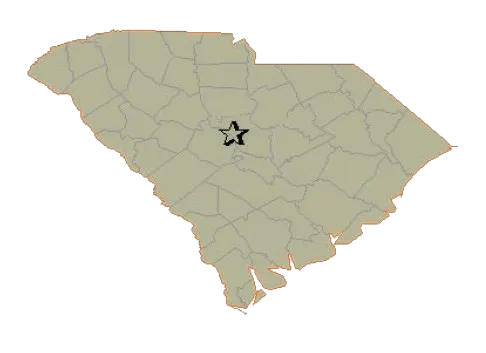
In a case that has tremendous implications for South Carolina voters, the U.S. Supreme Court has ruled in favor of South Carolina Republicans in a dispute over the boundaries of Congressional Districts 1 and 6. In a 6-3 decision, the court upheld the state’s congressional district map drawn by Republicans. The decision came in the lawsuit brought by the South Carolina State Conference of the NAACP, challenging the constitutionality of the map.
Democratic leaders were quick to condemn the ruling.
“Today’s U.S. Supreme Court decision in Alexander v. South Carolina State Conference of the NAACP is further affirmation that this court has chosen to disenfranchise Black voters and rob us of our fundamental access to the ballot box,” he said in a statement. “Equitable representation is the hallmark of a healthy democracy and in this case, the Supreme Court is attempting to steer the country back to a dark place in our history.”
After the 2020 Census,
South Carolina faced the task of redrawing its congressional district boundaries due to population shifts. The State Senate subcommittee responsible for the process aimed to balance traditional districting principles with the goal of creating a stronger Republican tilt in District 1.
After the redistricting plan was adopted, the South Carolina NAACP immediately filed a lawsuit challenging it. The NAACP argued that the legislature imposed a racial target of 1 7 % in Congressional District 1, which resulted in the exclusion of tens of thousands of Black Charlestonians. They contended that race played a predominant role in the redistricting decisions, triggering strict scrutiny under constitutional standards.
After an eight-day trial in late 2022, a three-judge federal panel ultimately concluded the GOP map was an unconstitutional racial gerrymander targeting Black voters.
In a 6-3 majority opinion, Justice Alito wrote that while partisan gerrymandering claims are not justiciable in federal court, maps that give race a dominant role are subject to strict scrutiny. The Court endorsed two key propositions: first, plaintiffs must disentangle race from politics to show that race was the legislature’s primary motivating factor; second, there is a presumption that the legislature acted in good faith.
The Court found that the NAACP failed to meet the high bar for a racial gerrymandering claim. Without an alternative map demonstrating that a rational legislature driven by partisan goals would have drawn a different map with greater racial balance, the starting presumption of good faith remained intact.
“Where race and partisan preferences are very closely tied, as they are here, the mere fact that District 1’s BVAP stayed more or less constant proves very little,” Alito wrote. ^ { \mathrm { * } } \mathrm { I f } 1 0 0 % of Black voters voted for Democratic candidates, it is obvious that any map with
the partisan breakdown that the legislature sought in District 1 — something in the range of 54 % Republican to 46 % Democratic — would inevitably involve the removal of a disproportionate number of Black voters.
“And since roughly 90% of Black voters cast their ballots for Democratic candidates, the same phenomenon is very likely,” he added.
Supreme Court Justice Elena Kagan wrote a dissenting opinion.
“The proper response to this case is not to throw up novel roadblocks enabling South Carolina to continue dividing citizens along racial lines,” Kagan wrote. “It is to respect the plausible — no, the more than plausible — findings of the district court that the state engaged in race-based districting. And to tell the state that it must redraw District 1, this time without targeting African-American citizens.”
The decision has significant implications for redistricting nationwide. It highlights the delicate balance between race and partisan preference, especially when they are highly correlated. While the Court upheld South Carolina’s map in this case, it underscores the ongoing debate over fair representation and the role of race in districting.
“Today, the Supreme Court has failed the American people. Voting rights have taken another gut punch, and the future of democracy in South Carolina is dangling by a thread. Make no mistake —we are not backing down from this fight,” said Brenda Murphy, president of the South Carolina State Conference of the NAACP. “Despite today’s news, the South Carolina NAACP will continue to utilize every resource at our disposal to ensure Black South Carolinians have an opportunity to make their voices heard in another pivotal election. This is what advocacy in action looks like.”
