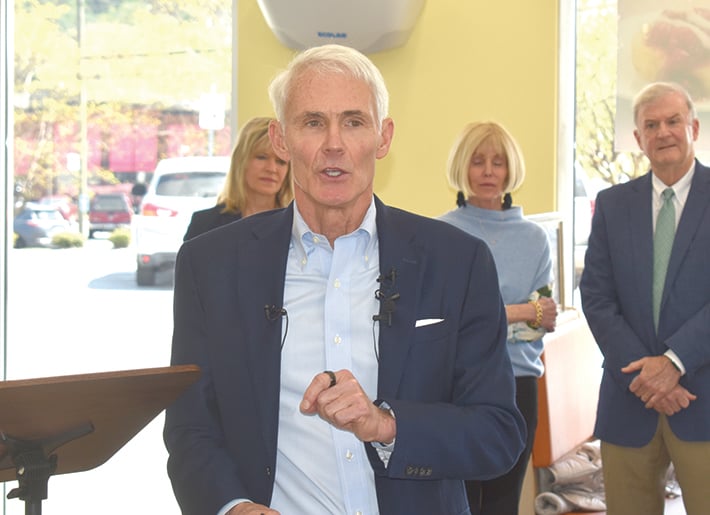
Billy Webster says his campaign for governor is about improving the lives of every South Carolinian
Billy Webster, a businessman and former public official, is running for governor of South Carolina, positioning himself as a problem-solver focused on health care expansion, education reform, and managing the state’s rapid growth.
Webster, who has led multiple businesses and held roles in both state and federal government, said his decision to run stems from both his professional experience and concerns about the tone of modern politics.
“I’ve spent my life in health care, education, and conservation,” Webster said in an interview. “When I look at the challenges South Carolina faces, I feel like my experience lines up with what the state needs right now.”
A central pillar of his campaign is expanding Medicaid, which he called “the only solution” to covering roughly 500,000 uninsured South Carolinians. Webster argued that the current system shifts billions of dollars in uncompensated care costs onto insured residents through higher premiums, while also contributing to the closure of rural hospitals.
“Rural hospitals are shutting down because they can’t absorb the cost of uninsured patients,” he said. “Expansion would not only insure people, but stabilize hospitals, reduce medical debt, and create tens of thousands of jobs.”
Beyond Medicaid, Webster said he would push for greater oversight of insurance rate increases and consider temporary measures such as suspending the gas tax if affordability worsens, though he acknowledged tradeoffs with infrastructure funding.
Education is another major focus, particularly in underserved regions often referred to as the “Corridor of Shame.” Webster emphasized early childhood investment and career-focused planning beginning in middle school.
“Every student should have a plan by eighth grade,” he said. “Whether it’s college, technical training, or the military, kids do better when they can see a path forward.”
He pointed to successful workforce development efforts tied to major employers like BMW in the Upstate as a model for aligning education with job opportunities statewide.
Webster also warned that South Carolina is unprepared for continued population growth. The state has added about one million residents over the past 15 years, with another million expected in the next decade.
“We don’t have the roads, the water systems, or the planning in place,” he said. “If we don’t act, South Carolina is going to become a parking lot.”
He called for a coordinated statewide strategy that integrates infrastructure, conservation, and development. Webster criticized what he described as “unwise development” and highlighted land conservation efforts as examples of balancing growth with environmental protection.
Energy policy and resource demand are also emerging concerns in the race, particularly with the rise of energy-intensive data centers. Webster expressed support for nuclear energy but criticized the state’s limited investment in renewable sources and called for more transparency and caution in approving large-scale projects.
“We can’t afford to get this wrong,” he said. “The demand on our power grid and water systems is only going to increase.”
In addition to policy priorities, Webster framed his campaign as a response to what he sees as a breakdown in political civility. He cited a controversial political incident earlier this year as a turning point in his decision to run.
“Politics has become a blood sport,” he said. “I don’t accept that’s how we should treat each other.”
If elected, Webster would face a Republican-dominated legislature, but he pointed to historical examples of bipartisan cooperation, including the Clinton administration’s work with Congress in the 1990s, as evidence that governing across party lines is possible.
“It takes mutual respect,” he said. “If you just yell at each other, nothing gets done.”
Webster, a Democrat, would be the first from his party elected governor in South Carolina in more than two decades if successful. He contrasted himself with what he described as “career politicians,” arguing that his background in business and public service makes him more action-oriented.
To learn more about Billy Webster and his quest to become South Carolna’s next governor, visit www.WebsterforSC.com.